W4. Set Theory, Cartesian Product, Power Set, Cardinality, Inclusion-Exclusion Principle
1. Summary
1.1 Introduction to Naive Set Theory
1.1.1 Definition of a Set
A set is a foundational concept in mathematics representing an unordered collection of distinct objects, known as its elements or members. The key characteristics of a set are:
- Unordered: The order in which elements are listed does not matter. For example, the set \({1, 2, 3}\) is identical to \({3, 1, 2}\).
- Distinct Elements: Each element in a set must be unique; duplicates are not counted. The collection \({a, a, b}\) is treated as the set \({a, b}\).
Sets can be described in two primary ways:
- List Method: Elements are explicitly listed inside curly braces. For instance, \(A = {0, 2, 4, 6, 8}\) describes the set of even digits.
- Rule Method (Set-Builder Notation): A rule or condition is specified that determines the elements of the set. For example, \(X = {x | x \% 2 = 0}\) defines the set of all even integers.
1.1.2 Set Equality and Membership
The Extension Principal states that two sets are considered equal if and only if they contain the exact same elements.
Membership defines the relationship between an element and a set.
- The symbol \(∈\) signifies that an element is part of a set. For example, \(3 ∈ {1, 2, 3}\) means “3 is an element of the set {1, 2, 3}”.
- The symbol \(∉\) signifies that an element is not part of a set. For example, \(4 ∉ {1, 2, 3}\).
1.2 Subsets and Special Sets
1.2.1 Subsets
A set \(A\) is a subset of a set \(B\) if every element of \(A\) is also an element of \(B\). This is denoted by \(A ⊆ B\).
- A set \(A\) is a proper subset of \(B\), denoted \(A ⊂ B\), if \(A\) is a subset of \(B\) but is not equal to \(B\) (i.e., \(B\) contains at least one element not in \(A\)).
For example, if \(A = {a, b}\) and \(B = {a, b, c}\), then \(A ⊆ B\) and \(A ⊂ B\).
1.2.2 Universal and Empty Sets
- The Universal Set (\(U\)) is a predefined set containing all possible elements relevant to a specific problem or context. All other sets in that context are subsets of \(U\).
- The Empty Set (\(\emptyset\) or \({}\)) is the unique set that contains no elements. It is a subset of every set, including itself.
1.3 Basic Set Operations
1.3.1 Complement
The complement of a set \(A\), denoted \(Ā\), consists of all elements in the universal set \(U\) that are not in \(A\). It is defined as \(Ā = {x ∈ U | x ∉ A}\).
1.3.2 Intersection
The intersection of two sets \(A\) and \(B\), denoted \(A ∩ B\), is the set containing all elements that are members of both \(A\) and \(B\).
1.3.3 Union
The union of two sets \(A\) and \(B\), denoted \(A ∪ B\), is the set containing all elements that are in \(A\), or in \(B\), or in both.
1.3.4 Difference
The difference between two sets \(A\) and \(B\), denoted \(A \ B\), is the set of all elements that are in \(A\) but not in \(B\). It can also be expressed as \(A ∩ B̄\).
1.4 Properties of Set Operations
Set operations follow several important algebraic properties, which are analogous to the laws of logic:
- Commutative Laws: \(A ∪ B = B ∪ A\) and \(A ∩ B = B ∩ A\).
- Associative Laws: \((A ∪ B) ∪ C = A ∪ (B ∪ C)\) and \((A ∩ B) ∩ C = A ∩ (B ∩ C)\).
- Distributive Laws: \(A ∪ (B ∩ C) = (A ∪ B) ∩ (A ∪ C)\) and \(A ∩ (B ∪ C) = (A ∩ B) ∪ (A ∩ C)\).
- De Morgan’s Laws: These laws provide a way to find the complement of a union or intersection.
- \((A ∪ B)̄ = Ā ∩ B̄\) (The complement of the union is the intersection of the complements).
- \((A ∩ B)̄ = Ā ∪ B̄\) (The complement of the intersection is the union of the complements).
1.5 Cardinality
The cardinality of a set \(A\), denoted \(|A|\), is the number of distinct elements in the set.
- For a finite set, the cardinality is a non-negative integer. For example, if \(A = {1, 2, 3}\), then \(|A| = 3\).
- The cardinality of the empty set is 0: \(|∅| = 0\).
- For infinite sets, cardinality describes the “size” of the infinity. Sets like the natural numbers (\(ℕ\)) are countably infinite, while sets like the real numbers (\(ℝ\)) are uncountably infinite.
1.6 Cartesian Product
The Cartesian Product of two sets \(A\) and \(B\), denoted \(A × B\), is the set of all possible ordered pairs \((a, b)\) where \(a\) is an element of \(A\) and \(b\) is an element of \(B\).
- Not Commutative: In general, \(A × B ≠ B × A\) because the ordering within the pairs matters.
- Cardinality: The cardinality of a Cartesian product is the product of the cardinalities of the individual sets: \(|A × B| = |A| * |B|\).
For example, if \(A = {1, 2}\) and \(B = {x, y}\), then \(A × B = {(1, x), (1, y), (2, x), (2, y)}\).
1.7 Power Set
The Power Set of a set \(A\), denoted \(P(A)\) or \(2^A\), is the set containing all possible subsets of \(A\), including the empty set and \(A\) itself.
- Cardinality: If \(|A| = n\), then the cardinality of its power set is \(|P(A)| = 2^n\).
For example, if \(A = {a, b}\), its power set is \(P(A) = {∅, {a}, {b}, {a, b}}\).
1.8 Inclusion-Exclusion Principle
This principle is a counting technique used to find the number of elements in the union of multiple sets without double-counting.
- For Two Sets: The cardinality of the union of \(A\) and \(B\) is the sum of their individual cardinalities minus the cardinality of their intersection. \[ |A ∪ B| = |A| + |B| - |A ∩ B| \]
- For Three Sets: The principle extends to three sets by adding the sizes of the individual sets, subtracting the sizes of all pairwise intersections, and adding back the size of the three-way intersection. \[ |A ∪ B ∪ C| = |A| + |B| + |C| - |A ∩ B| - |A ∩ C| - |B ∩ C| + |A ∩ B ∩ C| \]
2. Definitions
- Set: An unordered collection of distinct objects, called elements.
- Element: A member of a set.
- Subset (\(⊆\)): A set where all of its elements are also contained in another set.
- Proper Subset (\(⊂\)): A subset that is not equal to the original set.
- Universal Set (\(U\)): The set of all possible elements under consideration for a specific problem.
- Empty Set (\(∅\)): The set with no elements.
- Cardinality (\(|A|\)): The number of distinct elements in a set.
- Complement (\(Ā\)): The set of elements in the universal set that are not in set A.
- Intersection (\(∩\)): The set of elements common to two or more sets.
- Union (\(∪\)): The set of all elements present in two or more sets.
- Set Difference (\): The set of elements that are in one set but not another.
- Cartesian Product (\(×\)): The set of all ordered pairs from two sets.
- Power Set (\(P(A)\)): The set of all subsets of a set.
- Venn Diagram: A visual representation of sets as overlapping circles within a universal set rectangle.
3. Formulas
- Complement: \(\overline{A} = U \setminus A\)
- Difference: \(A \setminus B = A \cap \overline{B}\)
- De Morgan’s Law: \(\overline{(A \cup B)} = \overline{A} \cap \overline{B}\)
- De Morgan’s Law: \(\overline{(A \cap B)} = \overline{A} \cup \overline{B}\)
- Distributive Law: \(A \cap (B \cup C) = (A \cap B) \cup (A \cap C)\)
- Cardinality of a Union (Two Sets): \(|A \cup B| = |A| + |B| - |A \cap B|\)
- Cardinality of a Union (Three Sets): \[ |A \cup B \cup C| = |A| + |B| + |C| - |A \cap B| - |A \cap C| - |B \cap C| + |A \cap B \cap C| \]
- Cardinality of a Set Difference: \(|A \setminus B| = |A| - |A \cap B|\)
- Cardinality of a Cartesian Product: \(|A \times B| = |A| \cdot |B|\)
- Intersection of Cartesian Products: \((A \times C) \cap (B \times D) = (A \cap B) \times (C \cap D)\)
- Intersection of Power Sets: \(P(A) \cap P(B) = P(A \cap B)\)
4. Examples
4.1. Perform Set Operations (Lab 4, Task 1)
Let \(U = \{0, 1, 2, 3, 4, 5, 6, 7, 8, 9\}\) and \(A = \{1, 2, 9\}\), \(B = \{7, 8, 9\}\). List elements of \(\overline{A} \cap B\).
Click to see the solution
- Find the complement of A (\(\overline{A}\)): Find all elements in the universal set U that are not in A.
- A = {1, 2, 9}
- \(\overline{A} = \{0, 3, 4, 5, 6, 7, 8\}\).
- Find the intersection: Find the elements that are common to both \(\overline{A}\) and B.
- \(\overline{A} = \{0, 3, 4, 5, 6, 7, 8\}\)
- B = {7, 8, 9}
- The common elements are 7 and 8.
4.2. Perform Set Operations (Lab 4, Task 1.a)
Let \(U = \{0, 1, ..., 9\}\), \(A = \{0, 2, 4, 6, 8\}\), \(C = \{2, 3, 4, 5\}\). List the elements of \(\overline{A} \cup C\).
Click to see the solution
- Find the complement of A (\(\overline{A}\)):
- \(\overline{A} = \{1, 3, 5, 7, 9\}\).
- Find the union: Combine the elements of \(\overline{A}\) and C without duplication.
- \(\overline{A} = \{1, 3, 5, 7, 9\}\)
- \(C = \{2, 3, 4, 5\}\)
- The union is \(\{1, 2, 3, 4, 5, 7, 9\}\).
4.3. Perform Set Operations (Lab 4, Task 1.b)
Let \(A = \{0, 2, 4, 6, 8\}\), \(B = \{1, 3, 5, 7, 9\}\). List the elements of \(A \cap \overline{B}\).
Click to see the solution
- Find the complement of B (\(\overline{B}\)):
- The universal set is \(U = \{0, 1, ..., 9\}\).
- \(\overline{B} = \{0, 2, 4, 6, 8\}\).
- Find the intersection: Find the elements common to A and \(\overline{B}\).
- \(A = \{0, 2, 4, 6, 8\}\)
- \(\overline{B} = \{0, 2, 4, 6, 8\}\)
- The intersection is the entire set A.
4.4. Perform Set Operations (Lab 4, Task 1.c)
Let \(A = \{0, 2, 4, 6, 8\}\), \(C = \{2, 3, 4, 5\}\). List the elements of \(\overline{A \cap C}\).
Click to see the solution
- Find the intersection (\(A \cap C\)):
- \(A \cap C = \{2, 4\}\).
- Find the complement: Find all elements in U that are not in the intersection.
- The universal set is \(U = \{0, 1, ..., 9\}\).
- The complement of \(\{2, 4\}\) is \(\{0, 1, 3, 5, 6, 7, 8, 9\}\).
4.5. Perform Set Operations (Lab 4, Task 1.d)
Let \(U = \{0, 1, ..., 9\}\), \(B = \{1, 3, 5, 7, 9\}\), \(C = \{2, 3, 4, 5\}\), \(D = \{1, 6, 7\}\). List the elements of \((\overline{C} \setminus D) \cup B\).
Click to see the solution
- Find the complement of C (\(\overline{C}\)):
- \(\overline{C} = \{0, 1, 6, 7, 8, 9\}\).
- Find the set difference (\(\overline{C} \setminus D\)): Start with \(\overline{C}\) and remove any elements that are also in D.
- D = {1, 6, 7}. Removing these from \(\overline{C}\) leaves \(\{0, 8, 9\}\).
- Find the union: Combine the result from step 2 with set B.
- Result from step 2: \(\{0, 8, 9\}\)
- B = {1, 3, 5, 7, 9}
- The union is \(\{0, 1, 3, 5, 7, 8, 9\}\).
4.6. Perform Set Operations (Lab 4, Task 1.e)
Let \(U = \{0, 1, ..., 9\}\), \(A = \{0, 2, 4, 6, 8\}\), \(C = \{2, 3, 4, 5\}\), \(D = \{1, 6, 7\}\). List the elements of \(\overline{A \cap C \cap D}\).
Click to see the solution
- Find the intersection (\(A \cap C \cap D\)): Find elements that are present in all three sets.
- \(A = \{0, 2, 4, 6, 8\}\)
- \(C = \{2, 3, 4, 5\}\)
- \(D = \{1, 6, 7\}\)
- There are no elements common to all three sets. So, \(A \cap C \cap D = \emptyset\).
- Find the complement: The complement of the empty set is the entire universal set.
4.7. Construct Formula from Venn Diagram (Lab 4, Task 2)
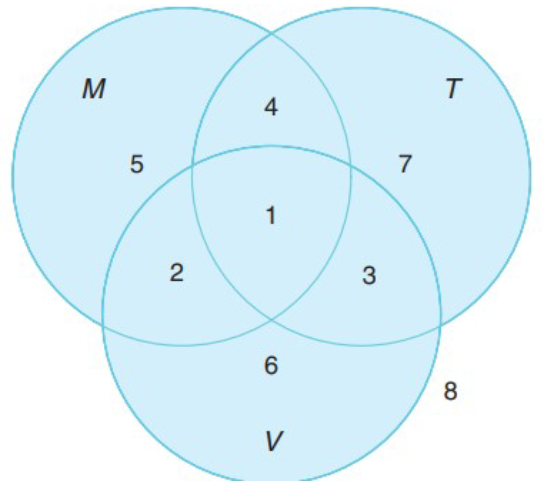
Referring to the following Venn diagram, construct the formula (using only \(\overline{()}\), \(\cap\), \(\cup\)) represented by region 1.
Click to see the solution
- Analyze Region 1: Region 1 is the area where all three sets, M, T, and V, overlap.
- Define the region: This area represents the elements that are present in set M AND set T AND set V.
- Write the formula: The intersection of the three sets represents this region.
4.8. Construct Formula from Venn Diagram (Lab 4, Task 2.a)
Referring to the Venn diagram, construct the formula for region 5.
Click to see the solution
- Analyze Region 5: This region is inside set M, but outside of sets T and V.
- Define the region: This means elements must be in M, AND NOT in T, AND NOT in V.
- Write the formula: This corresponds to the intersection of M, the complement of T, and the complement of V.
4.9. Construct Formula from Venn Diagram (Lab 4, Task 2.b)
Referring to the Venn diagram, construct the formula for region 3.
Click to see the solution
- Analyze Region 3: This region is in the intersection of T and V, but outside of M.
- Define the region: Elements must be in T, AND in V, AND NOT in M.
- Write the formula: This corresponds to the intersection of T, V, and the complement of M.
4.10. Construct Formula from Venn Diagram (Lab 4, Task 2.c)
Referring to the Venn diagram, construct the formula for regions 1 and 2 together.
Click to see the solution
- Analyze Regions 1 and 2: This combined area is the part of the intersection of M and V that is not necessarily in T.
- Define the region: Region 1 is \(M \cap T \cap V\). Region 2 is \(M \cap V \cap \overline{T}\).
- Combine the formulas: The union of these two regions is \((M \cap T \cap V) \cup (M \cap V \cap \overline{T})\).
- Simplify: We can factor out the common part, \(M \cap V\). This gives $ (M V) (T ) $. Since \(T \cup \overline{T}\) is the universal set, the expression simplifies to \(M \cap V\).
4.11. Construct Formula from Venn Diagram (Lab 4, Task 2.d)
Referring to the Venn diagram, construct the formula for regions 4 and 7 together.
Click to see the solution
- Analyze Regions 4 and 7: This combined area is the part of set T that is outside of set V.
- Define the region: The elements must be in T AND NOT in V.
- Write the formula: This is the intersection of T and the complement of V.
4.12. Construct Formula from Venn Diagram (Lab 4, Task 2.e)
Referring to the Venn diagram, construct the formula for regions 3, 6, 7, and 8 together.
Click to see the solution
- Analyze the regions: The combined area includes everything in T except region 4, everything in V except region 2, and the area outside all circles (region 8).
- Identify the excluded area: The excluded regions are 1, 2, 4, 5. This is the entire set M, along with region 4.
- Alternative approach: Let’s define the included area. It’s the union of T and V, but with region 1 and 2 removed. This is complex.
- Simpler approach: The area is everything that is outside of the part of M that doesn’t intersect with T or V (region 5). No, that’s not right.
- Let’s use complements: The area is the complement of regions {1, 2, 4, 5}. Regions {1, 2, 4, 5} is the set M united with region 4 (\(M \cup (T \cap \overline{M} \cap \overline{V})\)). This is also complex.
- Let’s check the sets: The desired area is \(\{3, 6, 7, 8\}\). This is everything outside of set M, except for region 4. So it’s \(\overline{M}\) with region 4 added back. That’s \(\overline{M} \cup (T \cap \overline{V} \cap \overline{M})\). That simplifies to \(\overline{M}\). Let’s check: \(\overline{M}\) = {3, 6, 7, 8}. This is correct.
4.13. Find the Cartesian Product (Lab 4, Task 3)
Let \(A = \{a, b\}\), \(C = \{0, 1\}\). List the elements of \(A \times C\) and count its cardinality.
Click to see the solution
- Definition of Cartesian Product: The product \(A \times C\) is the set of all ordered pairs (x, y) where \(x \in A\) and \(y \in C\).
- Form the pairs: Pair each element of A with each element of C.
- (a, 0), (a, 1)
- (b, 0), (b, 1)
- List the set of pairs: \(A \times C = \{(a, 0), (a, 1), (b, 0), (b, 1)\}\).
- Count the cardinality: The number of elements is \(|A| \times |C| = 2 \times 2 = 4\).
4.14. Perform Cartesian Product Operations (Lab 4, Task 3.a)
Let \(A = \{a, b, c\}\), \(B = \{b, c, d\}\). List the elements of \(A \times B\) and count its cardinality.
Click to see the solution
- Form the pairs: Pair each element of A with each element of B.
- (a, b), (a, c), (a, d)
- (b, b), (b, c), (b, d)
- (c, b), (c, c), (c, d)
- List the set: \(A \times B = \{(a, b), (a, c), (a, d), (b, b), (b, c), (b, d), (c, b), (c, c), (c, d)\}\).
- Cardinality: \(|A \times B| = |A| \times |B| = 3 \times 3 = 9\).
4.15. Perform Cartesian Product Operations (Lab 4, Task 3.b)
Let \(A = \{a, b, c\}\), \(B = \{b, c, d\}\), \(C = \{0, 1, 2\}\). List the elements of \((A \cap B) \times C\) and count its cardinality.
Click to see the solution
- Find the intersection (\(A \cap B\)):
- \(A \cap B = \{b, c\}\).
- Find the Cartesian product:
- \(\{b, c\} \times \{0, 1, 2\} = \{(b, 0), (b, 1), (b, 2), (c, 0), (c, 1), (c, 2)\}\).
- Cardinality: \(|A \cap B| \times |C| = 2 \times 3 = 6\).
4.16. Perform Cartesian Product Operations (Lab 4, Task 3.c)
Let \(A = \{a, b, c\}\), \(B = \{b, c, d\}\), \(C = \{0, 1, 2\}\), \(D = \{1, 2, 3\}\). List the elements of \((A \times C) \cap (B \times D)\).
Click to see the solution
- Find the intersection of the first elements (\(A \cap B\)):
- \(A \cap B = \{b, c\}\).
- Find the intersection of the second elements (\(C \cap D\)):
- \(C \cap D = \{1, 2\}\).
- Use the property \((A \times C) \cap (B \times D) = (A \cap B) \times (C \cap D)\):
- The result is \(\{b, c\} \times \{1, 2\}\).
- List the elements: \(\{(b, 1), (b, 2), (c, 1), (c, 2)\}\).
- Cardinality: \(|A \cap B| \times |C \cap D| = 2 \times 2 = 4\).
4.17. Perform Cartesian Product Operations (Lab 4, Task 3.d)
Let \(A = \{a, b, c\}\), \(B = \{b, c, d\}\), \(C = \{0, 1, 2\}\), \(D = \{1, 2, 3\}\). List the elements of \((A \times D) \cap (C \times B)\).
Click to see the solution
- Find the intersection of the first elements (\(A \cap C\)):
- \(A = \{a, b, c\}\), \(C = \{0, 1, 2\}\). There are no common elements. \(A \cap C = \emptyset\).
- Use the property \((A \times D) \cap (C \times B) = (A \cap C) \times (D \cap B)\):
- The result is \(\emptyset \times (D \cap B)\).
- Conclusion: The Cartesian product with an empty set is always the empty set.
4.18. Perform Cartesian Product Operations (Lab 4, Task 3.e)
Let \(A = \{a, b, c\}\), \(B = \{b, c, d\}\), \(C = \{0, 1, 2\}\), \(D = \{1, 2, 3\}\). List the elements of \(((A \cap B) \times D) \cup (B \times (C \cap D))\).
Click to see the solution
- Calculate the first part: \((A \cap B) \times D\)
- \(A \cap B = \{b, c\}\).
- \(\{b, c\} \times \{1, 2, 3\} = \{(b, 1), (b, 2), (b, 3), (c, 1), (c, 2), (c, 3)\}\).
- Calculate the second part: \(B \times (C \cap D)\)
- \(C \cap D = \{1, 2\}\).
- \(\{b, c, d\} \times \{1, 2\} = \{(b, 1), (b, 2), (c, 1), (c, 2), (d, 1), (d, 2)\}\).
- Find the union of the two resulting sets:
- Combine all unique elements from both parts.
- \(\{(b, 1), (b, 2), (b, 3), (c, 1), (c, 2), (c, 3), (d, 1), (d, 2)\}\).
- Cardinality: The union has 8 unique elements.
4.19. Find the Intersection of Power Sets (Lab 4, Task 4)
Let \(A = \{a, b\}\), \(B = \{b, c\}\). List the elements of \(P(A) \cap P(B)\).
Click to see the solution
- Find the Power Set of A, P(A): This is the set of all subsets of A.
- \(P(A) = \{\emptyset, \{a\}, \{b\}, \{a, b\}\}\).
- Find the Power Set of B, P(B): This is the set of all subsets of B.
- \(P(B) = \{\emptyset, \{b\}, \{c\}, \{b, c\}\}\).
- Find the intersection: Identify the elements (which are sets) that are common to both \(P(A)\) and \(P(B)\).
- The common subsets are \(\emptyset\) and \(\{b\}\).
4.20. Perform Power Set Operations (Lab 4, Task 4.a)
Let \(A = \{a, b, c\}\). List the elements of \(P(A)\).
Click to see the solution
- Definition of Power Set: The power set is the set of all possible subsets.
- List subsets by size:
- Size 0: \(\emptyset\)
- Size 1: \(\{a\}\), \(\{b\}\), \(\{c\}\)
- Size 2: \(\{a, b\}\), \(\{a, c\}\), \(\{b, c\}\)
- Size 3: \(\{a, b, c\}\)
- Combine all subsets into a single set.
4.21. Perform Power Set Operations (Lab 4, Task 4.b)
Let \(A = \{a, b, c\}\), \(C = \{c, d, e\}\). List the elements of \(P(A) \cap P(C)\).
Click to see the solution
- Use the property \(P(A) \cap P(C) = P(A \cap C)\): This is simpler than listing both power sets.
- Find the intersection (\(A \cap C\)):
- \(A \cap C = \{c\}\).
- Find the power set of the intersection:
- \(P(\{c\}) = \{\emptyset, \{c\}\}\).
4.22. Perform Power Set Operations (Lab 4, Task 4.c)
Let \(A = \{a, b, c\}\), \(B = \{b, c, d\}\). List the elements of \(P(A) \cap P(B)\).
Click to see the solution
- Use the property \(P(A) \cap P(B) = P(A \cap B)\):
- Find the intersection (\(A \cap B\)):
- \(A \cap B = \{b, c\}\).
- Find the power set of the intersection:
- \(P(\{b, c\}) = \{\emptyset, \{b\}, \{c\}, \{b, c\}\}\).
4.23. Perform Power Set Operations (Lab 4, Task 4.d)
Let \(A = \{a, b, c\}\), \(B = \{b, c, d\}\), \(C = \{c, d, e\}\). List the elements of \(P(A \cap B) \cup P(B \cap C)\).
Click to see the solution
- Calculate the first part (\(P(A \cap B)\)):
- \(A \cap B = \{b, c\}\).
- \(P(A \cap B) = \{\emptyset, \{b\}, \{c\}, \{b, c\}\}\).
- Calculate the second part (\(P(B \cap C)\)):
- \(B \cap C = \{c, d\}\).
- \(P(B \cap C) = \{\emptyset, \{c\}, \{d\}, \{c, d\}\}\).
- Find the union of the two power sets:
- Combine all unique elements from both sets.
- \(\{\emptyset, \{b\}, \{c\}, \{d\}, \{b, c\}, \{c, d\}\}\).
4.24. Perform Power Set Operations (Lab 4, Task 4.e)
Let \(B = \{b, c, d\}\), \(C = \{c, d, e\}\). List the elements of \(P(B) \setminus P(C)\).
Click to see the solution
- Find the Power Set of B, P(B):
- \(P(B) = \{\emptyset, \{b\}, \{c\}, \{d\}, \{b, c\}, \{b, d\}, \{c, d\}, \{b, c, d\}\}\).
- Find the Power Set of C, P(C):
- \(P(C) = \{\emptyset, \{c\}, \{d\}, \{e\}, \{c, d\}, \{c, e\}, \{d, e\}, \{c, d, e\}\}\).
- Find the difference: Start with \(P(B)\) and remove any elements that are also in \(P(C)\).
- Common elements are: \(\emptyset, \{c\}, \{d\}, \{c, d\}\).
- Removing these from \(P(B)\) leaves: \(\{b\}, \{b, c\}, \{b, d\}, \{b, c, d\}\).
4.25. Analyze a Survey Claim (Lab 4, Task 5)
A survey showed 80% like chocolate (C) and 60% like vanilla (V). 50% like both. A claim states 40% like only chocolate. Show this is false.
Click to see the solution
- Define the information:
- \(|C| = 80\%\)
- \(|V| = 60\%\)
- \(|C \cap V| = 50\%\)
- Calculate the percentage who like only chocolate: The number of people who like only chocolate is the total who like chocolate minus those who like both.
- \(|C \text{ only}| = |C| - |C \cap V|\)
- Substitute the values:
- \(|C \text{ only}| = 80\% - 50\% = 30\%\).
- Compare with the claim: The calculated value is 30%, but the claim is 40%.
4.26. Analyze a Survey Claim (Lab 4, Task 6)
Survey: 60% play soccer (S), 50% basketball (B), 70% tennis (T). Intersections: |S∩B|=30%, |S∩T|=35%, |B∩T|=30%. A claim states |S∩B∩T|=20%. Show this is false.
Click to see the solution
- Use the Inclusion-Exclusion Principle: The total number of people playing at least one sport, \(|S \cup B \cup T|\), cannot exceed 100%.
- \(|S \cup B \cup T| = |S|+|B|+|T| - (|S \cap B|+|S \cap T|+|B \cap T|) + |S \cap B \cap T|\)
- Substitute the given values and the claim:
- \(|S \cup B \cup T| = 60 + 50 + 70 - (30 + 35 + 30) + 20\)
- \(= 180 - 95 + 20\)
- \(= 85 + 20 = 105\).
- Analyze the result: The calculation gives a total of 105%.
- Conclusion: It is impossible for 105% of students to play at least one sport. The total cannot be more than 100%.
4.27. Analyze Survey Data (Lab 4, Task 7)
Survey: Robotics (R) 40%, Coding (C) 50%, Data Science (DS) 30%. Intersections: |R∩C|=20%, |R∩DS|=15%, |C∩DS|=10%, |R∩C∩DS|=5%. Find how many students participate in Robotics or Coding, but not in Data Science.
Click to see the solution
- Define the goal: We need to find the number of students in the set \((R \cup C) \setminus DS\).
- Use the formula: \(|(R \cup C) \setminus DS| = |R \cup C| - |(R \cup C) \cap DS|\).
- Calculate \(|R \cup C|\):
- \(|R \cup C| = |R| + |C| - |R \cap C| = 40\% + 50\% - 20\% = 70\%\).
- Calculate \(|(R \cup C) \cap DS|\): Using the distributive law, this is equal to \(|(R \cap DS) \cup (C \cap DS)|\).
- Apply Inclusion-Exclusion to the intersection:
- \(|(R \cap DS) \cup (C \cap DS)| = |R \cap DS| + |C \cap DS| - |(R \cap DS) \cap (C \cap DS)|\)
- The final term is just \(|R \cap C \cap DS|\).
- \(= 15\% + 10\% - 5\% = 20\%\).
- Calculate the final result:
- \(|(R \cup C) \setminus DS| = 70\% - 20\% = 50\%\).
4.28. Find the Complement of a Set (Tutorial 4, Task 1)
Let \(U = \{a, b, c, d, e\}\) and \(A = \{a, b, e\}\). List the elements of \(\overline{A}\).
Click to see the solution
- Definition of Complement: The complement of a set A, denoted \(\overline{A}\), contains all the elements in the universal set U that are not in A.
- Identify elements:
- U = {a, b, c, d, e}
- A = {a, b, e}
- Find elements in U but not in A: The elements ‘c’ and ‘d’ are in U but not in A.
4.29. Find the Complement of a Set (Tutorial 4, Task 2)
Let \(U = \{a, b, c, d, e\}\) and \(B = \{b, d, e\}\). List the elements of \(\overline{B}\).
Click to see the solution
- Definition of Complement: The complement of a set B, denoted \(\overline{B}\), contains all the elements in the universal set U that are not in B.
- Identify elements:
- U = {a, b, c, d, e}
- B = {b, d, e}
- Find elements in U but not in B: The elements ‘a’ and ‘c’ are in U but not in B.
4.30. Find the Intersection of Sets (Tutorial 4, Task 3)
Let \(A = \{a, b, e\}\) and \(B = \{b, d, e\}\). List the elements of \(A \cap B\).
Click to see the solution
- Definition of Intersection: The intersection of two sets, \(A \cap B\), contains all the elements that are common to both set A and set B.
- Identify common elements:
- A = {a, b, e}
- B = {b, d, e}
- Compare the sets: The elements ‘b’ and ‘e’ appear in both sets.
4.31. Find the Union of Sets (Tutorial 4, Task 4)
Let \(A = \{a, b, e\}\) and \(B = \{b, d, e\}\). List the elements of \(A \cup B\).
Click to see the solution
- Definition of Union: The union of two sets, \(A \cup B\), contains all the elements that are in set A, or in set B, or in both, without duplication.
- Combine elements:
- Elements from A: a, b, e
- Elements from B: b, d, e
- List unique elements: Combining them gives {a, b, e, d}.
4.32. Perform Set Operations (Tutorial 4, Task 6)
Let \(U = \{a, b, c, d, e\}\), \(A = \{a, b, e\}\), and \(B = \{b, d, e\}\). List the elements of \(\overline{A} \cap B\).
Click to see the solution
- Find the complement of A (\(\overline{A}\)): First, find all elements in U that are not in A.
- \(\overline{A} = U - A = \{c, d\}\).
- Find the intersection: Now, find the common elements between the result from step 1 and set B.
- \(\overline{A} = \{c, d\}\)
- \(B = \{b, d, e\}\)
- The common element is ‘d’.
4.33. Construct Formula from Venn Diagram (Tutorial 4, Task 7)
Referring to the following Venn diagram, construct the formula (using only \(\overline{()}\), \(\cap\), \(\cup\)) represented by region 2. 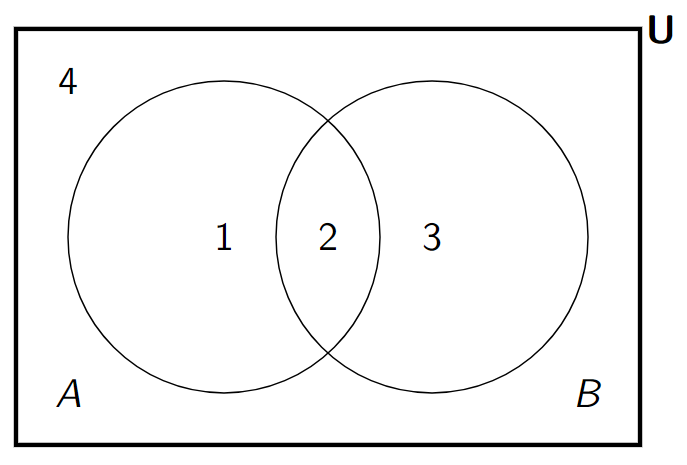
Click to see the solution
- Analyze Region 2: Region 2 represents the area where the circles for set A and set B overlap.
- Define the region: This overlapping area is the definition of the intersection of the two sets.
- Write the formula: The intersection of A and B is written as \(A \cap B\).
4.34. Construct Formula from Venn Diagram (Tutorial 4, Task 8)
Referring to the following Venn diagram, construct the formula (using only \(\overline{()}\), \(\cap\), \(\cup\)) represented by region 1.
Click to see the solution
- Analyze Region 1: Region 1 is the part of set A that does not overlap with set B.
- Define the region: This means we want elements that are in A AND are NOT in B.
- Write the formula: “NOT in B” is the complement of B, or \(\overline{B}\). The condition “in A AND NOT in B” translates to the intersection of A and \(\overline{B}\).
4.35. Construct Formula from Venn Diagram (Tutorial 4, Task 9)
Referring to the following Venn diagram, construct the formula (using only \(\overline{()}\), \(\cap\), \(\cup\)) represented by region 4.
Click to see the solution
- Analyze Region 4: Region 4 is the area outside of both circles A and B, but inside the universal set U.
- Define the region: This means we want elements that are NOT in A AND are NOT in B.
- Write the formula: This translates to the intersection of the complements of A and B.
- Alternative Formula: Region 4 is also the complement of the union of A and B.
4.36. Construct Formula from Venn Diagram (Tutorial 4, Task 10)
Referring to the following Venn diagram, construct the formula (using only \(\overline{()}\), \(\cap\), \(\cup\)) represented by regions 1, 2, and 4 together.
Click to see the solution
- Identify the excluded region: The combined area includes everything except for region 3.
- Define the excluded region: Region 3 represents the part of B that is not in A. The formula for region 3 is \(B \cap \overline{A}\).
- Find the complement: The desired area is the complement of region 3.
- Write the formula: The formula is \(\overline{(B \cap \overline{A})}\).
- Simplify using De Morgan’s Law: \(\overline{(B \cap \overline{A})} = \overline{B} \cup \overline{(\overline{A})} = \overline{B} \cup A\). Let’s verify: A is regions {1, 2}, \(\overline{B}\) is regions {1, 4}. Their union is {1, 2, 4}.
4.37. Construct Formula from Venn Diagram (Tutorial 4, Task 11)
Referring to the following Venn diagram, construct the formula (using only \(\overline{()}\), \(\cap\), \(\cup\)) represented by region 1.
Click to see the solution
- Analyze Region 1: Region 1 is the central area where all three circles (M, T, and V) overlap.
- Define the region: This area represents the elements that are common to all three sets.
- Write the formula: This is the intersection of the three sets.
4.38. Find the Cartesian Product (Tutorial 4, Task 12)
Let \(A = \{a, b\}\) and \(B = \{0, 1\}\). List the elements of \(A \times B\).
Click to see the solution
- Definition of Cartesian Product: The Cartesian product \(A \times B\) is the set of all ordered pairs (x, y) where x is an element of A and y is an element of B.
- Form the pairs: Pair each element of A with each element of B.
- Pair ‘a’ with ‘0’ and ‘1’: (a, 0), (a, 1)
- Pair ‘b’ with ‘0’ and ‘1’: (b, 0), (b, 1)
- List the set of pairs.
4.39. Find the Cartesian Product (Tutorial 4, Task 13)
Let \(A = \{a, b\}\). List the elements of \(A \times A\).
Click to see the solution
- Definition of Cartesian Product: The Cartesian product \(A \times A\) (also denoted \(A^2\)) is the set of all ordered pairs (x, y) where both x and y are elements of A.
- Form the pairs: Pair each element of A with every element of A.
- Pair ‘a’ with ‘a’ and ‘b’: (a, a), (a, b)
- Pair ‘b’ with ‘a’ and ‘b’: (b, a), (b, b)
- List the set of pairs.
4.40. Prove a Property of Cartesian Products (Tutorial 4, Task 14)
Prove that \(\exists A (A^2 \neq A)\).
Click to see the solution
- Goal: We need to find at least one example of a set A for which the Cartesian product \(A \times A\) is not equal to the set A itself.
- Choose a simple set: Let \(A = \{1\}\).
- Calculate \(A^2\): \(A^2 = A \times A = \{1\} \times \{1\} = \{(1, 1)\}\).
- Compare A and \(A^2\):
- \(A = \{1\}\)
- \(A^2 = \{(1, 1)\}\)
- Conclusion: The set A contains the number 1, while the set \(A^2\) contains the ordered pair (1, 1). These are different types of objects, so the sets are not equal.
4.41. Prove a Property of Cartesian Products (Tutorial 4, Task 15)
Prove that \(\exists A, B (A \times B \neq B \times A)\).
Click to see the solution
- Goal: We need to find an example of two sets A and B where the Cartesian product is not commutative.
- Choose simple, different sets: Let \(A = \{1\}\) and \(B = \{2\}\).
- Calculate \(A \times B\): \(A \times B = \{1\} \times \{2\} = \{(1, 2)\}\).
- Calculate \(B \times A\): \(B \times A = \{2\} \times \{1\} = \{(2, 1)\}\).
- Compare the results: The ordered pair (1, 2) is not the same as the ordered pair (2, 1). Therefore, the sets containing them are not equal.
4.42. Find the Cartesian Product of Three Sets (Tutorial 4, Task 17)
Let \(A = \{a, b\}\), \(B = \{x, y\}\), \(C = \{1, 2\}\). List the elements of \(A \times B \times C\) and count its cardinality.
Click to see the solution
- Definition of Cartesian Product: The product \(A \times B \times C\) is the set of all ordered triples (i, j, k) where \(i \in A\), \(j \in B\), and \(k \in C\).
- Form the triples: Systematically combine one element from each set.
- Starting with ‘a’ from A and ‘x’ from B: (a, x, 1), (a, x, 2)
- Starting with ‘a’ from A and ‘y’ from B: (a, y, 1), (a, y, 2)
- Starting with ‘b’ from A and ‘x’ from B: (b, x, 1), (b, x, 2)
- Starting with ‘b’ from A and ‘y’ from B: (b, y, 1), (b, y, 2)
- List the set of triples: The full set is \(\{(a, x, 1), (a, x, 2), (a, y, 1), (a, y, 2), (b, x, 1), (b, x, 2), (b, y, 1), (b, y, 2)\}\).
- Calculate Cardinality: The cardinality is \(|A| \times |B| \times |C| = 2 \times 2 \times 2 = 8\).
4.43. Find the Power Set (Tutorial 4, Task 18)
Let \(A = \{0\}\). List the elements of \(P(A)\).
Click to see the solution
- Definition of Power Set: The power set of A, denoted P(A), is the set of all possible subsets of A.
- Identify subsets:
- The empty set is a subset of every set: \(\emptyset\).
- The set A itself is a subset: \(\{0\}\).
- List the set of subsets.
4.44. Find the Power Set (Tutorial 4, Task 19)
Let \(A = \{x, y\}\). List the elements of \(P(A)\).
Click to see the solution
- Definition of Power Set: The power set of A, denoted P(A), is the set of all subsets of A.
- Identify subsets:
- Subset with 0 elements: \(\emptyset\).
- Subsets with 1 element: \(\{x\}\), \(\{y\}\).
- Subset with 2 elements: \(\{x, y\}\).
- List the set of all subsets.
4.45. Find the Power Set of a Union (Tutorial 4, Task 20)
Let \(A = \{1, 2\}\), \(B = \{1, 3\}\). List the elements of \(P(A \cup B)\).
Click to see the solution
- Calculate the Union: First, find the set \(A \cup B\).
- \(A \cup B = \{1, 2, 3\}\).
- Find the Power Set: Now, find all subsets of \(\{1, 2, 3\}\).
- Subset with 0 elements: \(\emptyset\).
- Subsets with 1 element: \(\{1\}\), \(\{2\}\), \(\{3\}\).
- Subsets with 2 elements: \(\{1, 2\}\), \(\{1, 3\}\), \(\{2, 3\}\).
- Subset with 3 elements: \(\{1, 2, 3\}\).
- List the set of subsets.
4.46. Find the Difference of Power Sets (Tutorial 4, Task 21)
Let \(A = \{1, 2\}\), \(B = \{1, 3\}\). List the elements of \(P(A) \setminus P(B)\).
Click to see the solution
- Find the Power Set of A:
- \(P(A) = \{\emptyset, \{1\}, \{2\}, \{1, 2\}\}\).
- Find the Power Set of B:
- \(P(B) = \{\emptyset, \{1\}, \{3\}, \{1, 3\}\}\).
- Calculate the Difference: The set difference \(P(A) \setminus P(B)\) contains all elements that are in \(P(A)\) but not in \(P(B)\).
- Compare the two power sets and remove common elements from \(P(A)\). The common elements are \(\emptyset\) and \(\{1\}\).
- The remaining elements in \(P(A)\) are \(\{2\}\) and \(\{1, 2\}\).
4.47. Find the Intersection of Power Sets (Tutorial 4, Task 22)
Let \(A = \{a, b\}\), \(B = \{b, c\}\). List the elements of \(P(A) \cap P(B)\).
Click to see the solution
- Find the Power Set of A:
- \(P(A) = \{\emptyset, \{a\}, \{b\}, \{a, b\}\}\).
- Find the Power Set of B:
- \(P(B) = \{\emptyset, \{b\}, \{c\}, \{b, c\}\}\).
- Find the Intersection: The intersection contains all elements that are common to both power sets.
- Comparing the two sets, the common elements are \(\emptyset\) and \(\{b\}\).
- Note: The intersection of power sets is equal to the power set of the intersection: \(P(A) \cap P(B) = P(A \cap B)\). Here \(A \cap B = \{b\}\), and \(P(\{b\}) = \{\emptyset, \{b\}\}\).
4.48. Use the Principle of Inclusion-Exclusion (Tutorial 4, Task 23)
How many bitstrings of length 8 start with a bit 1 or end with 10?
Click to see the solution
- Define the sets:
- Let A be the set of 8-bit strings that start with 1.
- Let B be the set of 8-bit strings that end with 10.
- Use the Inclusion-Exclusion Principle: We want to find \(|A \cup B| = |A| + |B| - |A \cap B|\).
- Calculate |A|: The string is
1 _ _ _ _ _ _ _. There are 7 positions that can be 0 or 1.- \(|A| = 2^7 = 128\).
- Calculate |B|: The string is
_ _ _ _ _ _ 1 0. There are 6 positions that can be 0 or 1.- \(|B| = 2^6 = 64\).
- Calculate |A ∩ B|: This is the set of strings that start with 1 AND end with 10. The string is
1 _ _ _ _ _ 1 0. There are 5 positions that can be 0 or 1.- \(|A \cap B| = 2^5 = 32\).
- Calculate the final result:
- \(|A \cup B| = 128 + 64 - 32 = 160\).
4.49. Use the Principle of Inclusion-Exclusion (Tutorial 4, Task 24)
In a group of 100 students: 45 play football (F), 35 play basketball (B), 30 play volleyball (V). 15 play F & B, 10 play F & V, 8 play B & V, and 5 play all three. Find:
- The number of students who play at least one sport
- The number of students who play exactly one sport
- The number of students who do not play any sports
Click to see the solution
- Part (a): At least one sport: We need to find \(|F \cup B \cup V|\).
- Use the Principle of Inclusion-Exclusion for three sets:
- \(|F \cup B \cup V| = |F| + |B| + |V| - (|F \cap B| + |F \cap V| + |B \cap V|) + |F \cap B \cap V|\)
- \(= 45 + 35 + 30 - (15 + 10 + 8) + 5\)
- \(= 110 - 33 + 5 = 82\).
- Part (c): Do not play any sports: This is the total number of students minus the number who play at least one sport.
- \(100 - |F \cup B \cup V| = 100 - 82 = 18\).
- Part (b): Exactly one sport: We find the number of students who play only one sport and sum them.
- Only F = \(|F| - |F \cap B| - |F \cap V| + |F \cap B \cap V| = 45 - 15 - 10 + 5 = 25\).
- Only B = \(|B| - |F \cap B| - |B \cap V| + |F \cap B \cap V| = 35 - 15 - 8 + 5 = 17\).
- Only V = \(|V| - |F \cap V| - |B \cap V| + |F \cap B \cap V| = 30 - 10 - 8 + 5 = 17\).
- Total playing exactly one sport = \(25 + 17 + 17 = 59\).
Answer:
- 82 students play at least one sport.
- 59 students play exactly one sport.
- 18 students do not play any sports.